TWIL #019 - The Telescope Fish Sees in All Directions at Once
The telescope fish has giant tubular eyes that point upward to spot prey from below - and can swallow fish larger than its own body.
- #animals
- #marine-biology
- #deep-sea
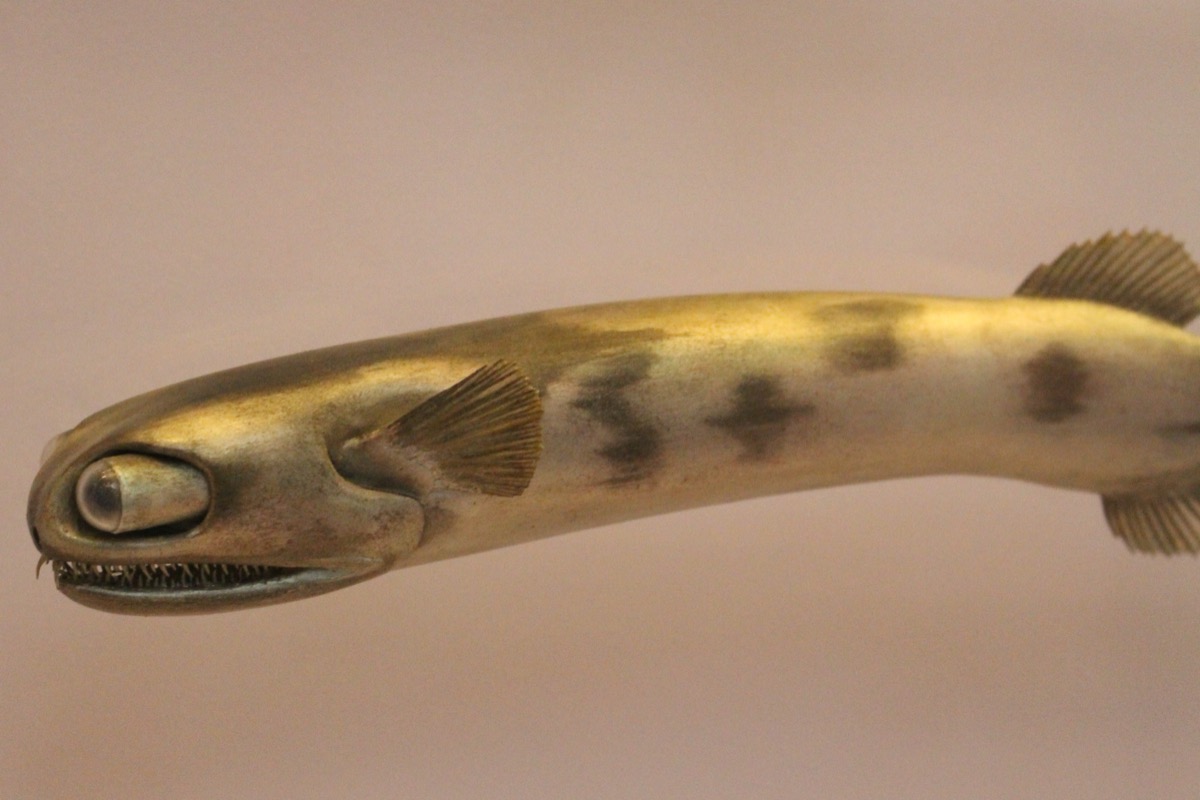
At depths between 500 and 3,000 metres, where sunlight barely reaches, the telescope fish (Gigantura species) has evolved one of the most striking visual systems in the ocean.
Its eyes are large, forward-facing, and tubular - fixed in their sockets and pointing upward. This gives the fish binocular vision directed toward the faint silhouettes of prey above it, maximising the ability to detect anything outlined against the dim light filtering down from the surface. The tubular shape packs in as many rod photoreceptors as possible, maximising sensitivity in near-total darkness.
Despite its dramatic visual apparatus, the telescope fish itself is small - typically 5 to 15 cm long. Its body is almost completely transparent, another deep-sea adaptation that makes it invisible to predators looking from the side.
What it lacks in size it makes up for in appetite. The telescope fish has a highly distensible jaw and a stomach that can expand dramatically, allowing it to swallow prey larger than its own body whole. The exact mechanism isn't fully understood, but it's a pattern common in deep-sea fish that can't afford to pass up a meal when food is scarce.
It's one of those creatures that looks almost impossible - part binoculars, part transparent ghost, with a jaw designed to eat things bigger than itself - all crammed into a fish you could fit in your palm.