TWIL #068 - The Oloid Is a Geometric Shape That Rolls Across Its Entire Surface
The oloid is a 3D shape formed from two perpendicular circles of equal radius. When placed on a flat surface, it rolls in a wobbling path and - uniquely - brings every point on its surface into contact with the ground.
- #mathematics
- #geometry
- #science
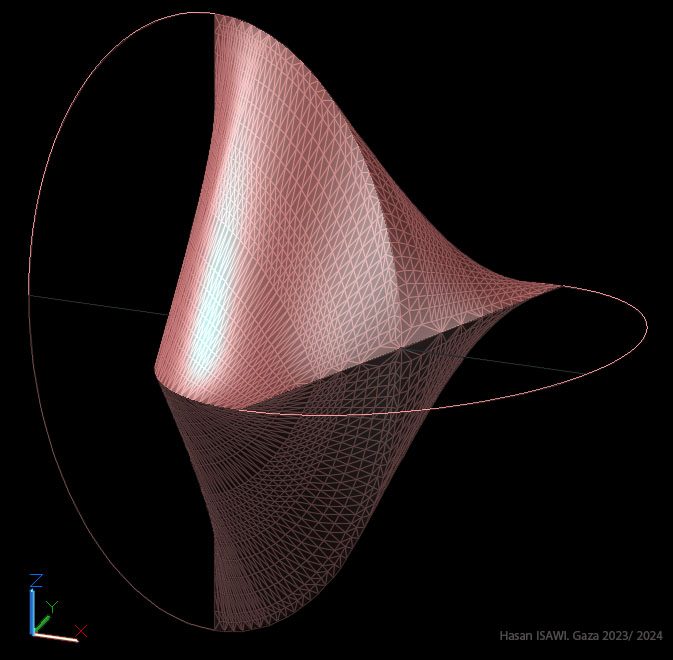
The oloid is a three-dimensional geometric solid discovered by Swiss sculptor and engineer Paul Schatz in 1929. It is constructed by taking two circles of equal radius, placing them so their centres are exactly one radius apart, and orienting them perpendicular to each other, so each circle passes through the centre of the other. The convex hull of these two circles - the smallest convex shape enclosing them - is the oloid.
How it rolls: When placed on a flat surface, the oloid rolls in a smooth, rocking, figure-eight-like path. But what makes it geometrically remarkable is that it is one of very few shapes that is developable - meaning its entire curved surface can be unrolled flat without distortion - and which, as it rolls, brings every point on its surface into contact with the plane beneath it.
Most shapes that roll (spheres, cylinders) only touch the ground along a single point or line at any moment, and large portions of the surface never contact the ground at all. The oloid's rolling motion is such that, over one complete cycle, the entire surface has touched the flat plane. Its surface area is exactly 4πr² - the same as a sphere of radius r.
What it is not: The oloid is different from a Reuleaux triangle (a shape of constant width) and different from a sphericon (formed from two semicircles). Each has different rolling properties.
Applications: The oloid's rolling motion creates an efficient mixing pattern in three dimensions. Paul Schatz developed oloid-based mixers that use this property - a rotating oloid inside a liquid produces a chaotic, three-dimensional flow with no stable centre of rotation, making it highly effective for mixing at low energy input. These are used in some industrial mixing and water treatment applications.